

The evidence-based,
data-led platform.
Our CEO talks data.
The Science Behind REACH Profiles, 360's and Culture
Download the REACH Technical Report here.
REACH Reliability
REACH reporting of human characteristics (psychometrics) and REACH Skills (that result in growth in agility) are reliable. The most common measure used is the Cronbach Alpha, in which a score of .7 is considered 'reliable' by industry standards. The Psychometric aspects of REACH has a Cronbach Alpha of around .8. The REACH Skills aspects has a Cronbach Alpha of .95 – both well above industry reliability standards.
Test / Re-test Reliability
REACH research demonstrates that human traits remain reasonably constant in test/re-test research; however, REACH Quotient (agility grown through skills development and increased awareness) can grow over time.
What is REACH?
REACH measures agility to adapt to the needs of different people, situations and tasks.
REACH provides clear insights into agility, preferences and skills of:
- Individual Contributors
- Leaders
- Organisational Behaviours that Impact Engagement
REACH combines the science of analysing human traits using psychometrics together with measuring agility (REACH) that can be grown by developing awareness, skills, resilience and a growth mindset.
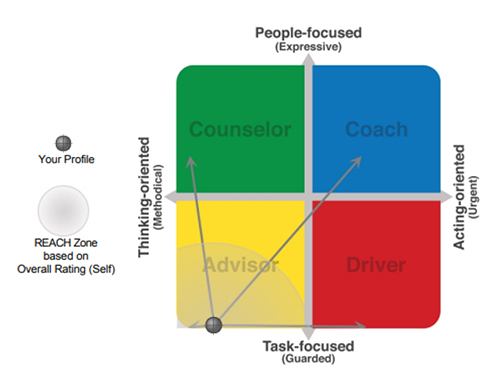
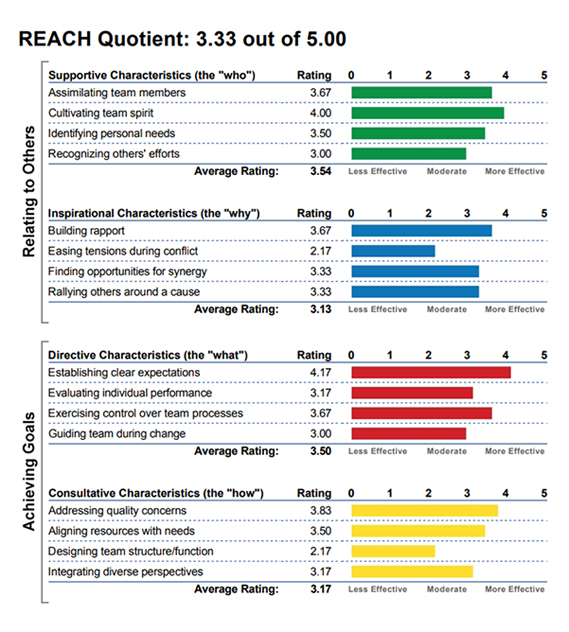
REACH is measured as a Quotient (a score out of 5) and is visually represented by an individual's REACH Zone.
An individual's primary archetype is identified as one of 4 primary styles: Counselor (green), Coach (blue), Advisor (yellow) and Driver (red), growing agility into the other styles is achieved by developing the skills most commonly associated with the other primary styles.
REACH is used by organisations to improve performance and engagement today, and build capability to thrive in the future of work. The REACH Ecosystem is the solution to help people thrive in our Volatile, Unpredictable, Complex and Ambiguous (VUCA) world with clarity and simplicity.
The REACH Framework uses Trait Characteristics, Functional Skills and Self-Awareness to Target and Measure Growth
Relating Dimensions
How individuals tend to interact with others in common settings.
- Affiliation
- Consideration
- Openness
- Status Motivation
- Self-Protection
Achieving Dimensions
How individuals approach tasks and goals under normal circumstances.
- Intensity
- Assertiveness
- Risk Tolerance
- Adaptability
- Decision-Making
16 Skills Grouped into Four Clusters
The Who
Supportive Characteristics
- • Assimilating team members
- • Cultivating team spirit
- • Identifying personal needs
- • Recognising others' efforts
The How
Consultative Characteristics
- • Addressing quality concerns
- • Aligning resources with needs
- • Designing team structure/function
- • Integrating diverse perspectives
The Why
Inspirational Characteristics
- • Building rapport
- • Easing tensions during conflict
- • Finding opportunities for synergy
- • Rallying others around a cause
The What
Directive Characteristics
- • Establishing clear expectations
- • Evaluating individual performance
- • Exercising control over team processes
- • Guiding team during change
Growing REACH represents agility to use different skills to move along the Relational (RE) Continuum and the Achievement (ACH) Continuum. Use learned awareness and skills to purposefully 'shift gear' into a different archetype to be more effective in more situations.
Neuroscience
REACH in Neuroscience
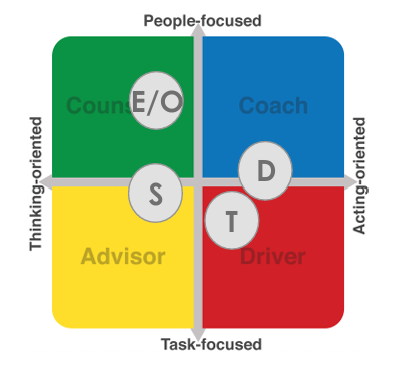
When people shift into different REACH styles (Counsellor, Coach, Driver, Advisor), they have correspondingly different brain functions and neurochemical release of Dopamine, Testosterone, Estrogen/Oxytocin and Serotonin.
REACH and Strengths Finder Construct Validity
REACH Styles identify with the following Strengths more often than others: